Need engaging, kid-friendly wildlife flash cards that support early literacy and science skills? This guide highlights five top options designed for curious learners, from toddlers to early elementary students. Each product is chosen for clear animal images, structured learning cues, and practical play ideas. Best for parents, teachers, and caregivers seeking portable, screen-free learning tools that cover animals from zoos and safaris to everyday critters.
Summary Table
| Product | Best For | Why It Stands Out | Limitations to Know |
|---|---|---|---|
| Carson Dellosa 54 Animal Flash Cards | Toddlers to Preschoolers | Full-color photos and interactive practice for core skills | Single-set scope; may need supplementary cards for older kids |
| My First 120 Animals (60 Cards) | Preschool to Early Elementary | Large 4” x 6” cards, categorized for easy learning | Double-sided 120 animals require careful organization |
| QUOKKA 104 Animal Flash Cards | Kindergarten to ESL/ABA contexts | Realistic images; broad daily object and animal vocabulary | More general vocabulary than animal-only focus |
| Little Known Truths Zoo Animal Trivia Flash Cards | Kids 3-5; STEM-minded learners | Fact-focused questions and life-like images | Limited to trivia style; less structured practice |
| Menique Wild Animals Memory Matching Game | Family play and cognitive training | 40 pairs with a related educational booklet | Focus on memory game format; not a pure flash card deck |
Carson Dellosa 54 Animal Flash Cards

This set includes a broad range of animals across zoo, reptile, bug, and sea creature categories. The full-color photographs enable quick visual recognition, and the hands-on format supports skill practice in early literacy and vocabulary building. Best for parents and early educators seeking a compact, image-forward tool to introduce basic animal facts and categorization.
Best for: toddlers to preschoolers who benefit from vivid imagery and simple fact exploration. The card deck supports color recognition, categorization, and conversational prompts. Caution: the deck’s scope may be narrower for kids beyond early elementary; consider pairing with additional animal-themed materials for deeper study.
My First 120 Animals (60 Cards)

This value pack includes 60 double-sided cards featuring 120 realistic animals, organized into five categories: farm, marine, wild, insects, and birds. Large 4” x 6” cards are kid-friendly and easy to handle. The included reclosable rings help teachers and parents keep cards organized and portable for on-the-go learning. Best for: preschool and early elementary learners who benefit from category-based exploration and large visual references.
Best for: expanding animal knowledge through hands-on sorting and quick recall. Better for: families who want a compact, portable library of animals. Caution: organizing 120 faces across five categories may require guidance for younger children new to classification.
QUOKKA 104 Animal Flash Cards
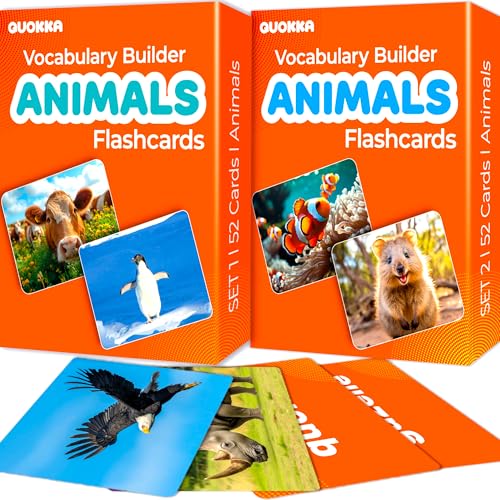
These jumbo cards present 104 realistic images to support vocabulary development and daily object association, suitable for ABA therapy, ESL, and early childhood education. Bold fonts aid visibility in group settings, and the wide animal range helps with cross-curricular learning. Best for: classrooms and homes needing a broad, visually rich vocabulary tool. Caution: is not strictly a wildlife-only set and includes non-animal nouns, so plan to pair with animal-focused activities.
Why chosen: strong visual clarity, broad everyday vocabulary, and compatibility with therapy or structured learning plans. Avoid if you need a strictly animal-only deck with uniform animal-centric activities.
Little Known Truths Zoo Animal Trivia Flash Cards

These zoo-themed flash cards pair high-resolution, life-like animal images with fun facts and quiz-style questions. The format supports curiosity-driven learning and STEM-related discussions about lions, monkeys, elephants, and more. Best for: young children ages 3-5 who enjoy trivia and rapid recall challenges. Caution: the trivia focus means fewer explicit reading prompts on the back compared to traditional fact cards.
Menique Wild Animals Memory Matching Game
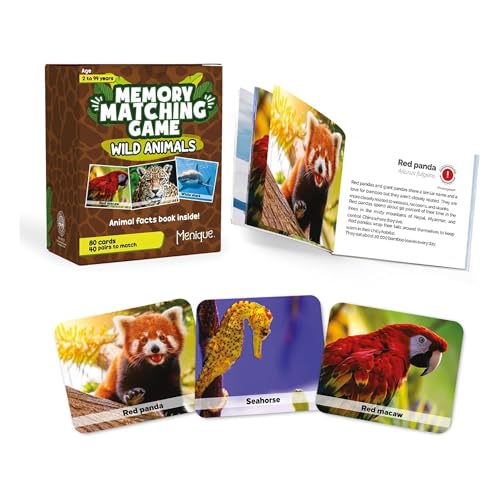
This memory-matching game includes 80 cards with real animal photos and a complementary educational booklet. It strengthens memory, visual perception, and cognitive skills while introducing basic animal facts through the booklet. Best for: families and classroom activities that value cooperative play and cognitive challenge. Caution: not a traditional single-card deck; players must manage memory strategy to perform well.
Buying Guide: Key Purchase Considerations
- Learning goals: Do you want basic image recognition, vocabulary building, or memory-based games? Choose decks that explicitly support your target outcomes.
- Age range: For toddlers, prioritize large, colorful images and simple labels. For older kids, look for more complex facts, categories, or quiz formats.
- Card size and durability: Larger cards reduce handling difficulty for small hands; consider sturdy packaging or storage options for portability.
- Organization features: Sets with rings or boxes help with sorting and rotation to maintain engagement.
- Subject breadth: If you want a broader zoological vocabulary, pick decks with diverse animal types; for focused topics, select theme-centered sets (zoo, safari, etc.).
- Supplemental materials: Some decks include booklets or fact sheets—these can enrich discussion and activities beyond card play.
How to Use These Flash Cards Effectively
- Partner play: Use turn-taking to promote language use and rapid recall.
- Category games: Have children sort cards by habitat, size, or type to reinforce classification skills.
- Story prompts: Combine cards with short prompts to build storytelling and comprehension.
FAQ
- What age are wildlife flash cards best for? – Most of these sets are suitable for ages 3 and up, with some options fitting preschool and early elementary learners.
- Can flash cards support language development? – Yes. Cards with bold images and accompanying facts or questions help develop vocabulary and comprehension.
- Are these cards durable for travel? – Several sets include rings or tins and larger cards making them portable for road trips or classroom activities.
- Should I buy multiple sets? – If you want broader animal coverage and varied activities (memory, trivia, classification), combining two or more sets offers richer opportunities.
- Do these cards include activity ideas? – Some sets provide educational booklets or suggest play formats; others rely on teacher or parent-created activities.