Discover durable, hands-on rubber band powered toys that encourage experiments in flight, motion, and engineering. This guide highlights five well‑rounded options ideal for kids, classrooms, and curious hobbyists. Each pick emphasizes easy assembly, clear mechanics, and educational value for different ages and interests.
The following table summarizes the five selected products, outlining who they’re best for and why they stand out.
| Product | Best For | Why It Stands Out |
|---|---|---|
| PLAYSTEM Balsa Wood Airplane Kit | Young builders and STEM learners | Easy slot-tab assembly; long flight up to 50 ft; nostalgic balsa wood design |
| GRANITE MOUNTAIN Balsa Wood Airplane Kit | Beginner to intermediate builders | Four planes per set; no glue; wind-up rubber band power; classic balsa |
| Guillow Paul K, Inc 60 Balsa Airplane Strato Streak | Traditional model builders | Classic rubber band powered glider; assembly required |
| Thames & Kosmos Rubber Band Racers Kit | Group projects and classrooms | Multiple models; educational manual; lightweight parts |
| Rubber Band Propeller Car Kit (10-Pack) | Classrooms and STEM clubs | 10 cars per kit; energy-to-motion experiments; no glue |
PLAYSTEM Balsa Wood Airplane Kit – 4 Pack

This kit uses reinforced noses and 12″ wings to achieve flight up to 50 feet when powered by a rubber band. It emphasizes easy assembly with a no-glue slot-tab design, letting kids slide wings into pre-cut slots for quick build and flight. Made from ultra-lightweight, splinter-free balsa, it delivers a classic feel with modern quality.
Best for younger hobbyists who want quick, reliable flights and a nostalgic build experience. Choose this if you want a ready-to-fly, family-friendly set that concentrates on basic aerodynamics and manual dexterity. A potential limitation is that performance depends on consistent hand launches and proper wing alignment.
GRANITE MOUNTAIN Balsa Wood Airplane Kit
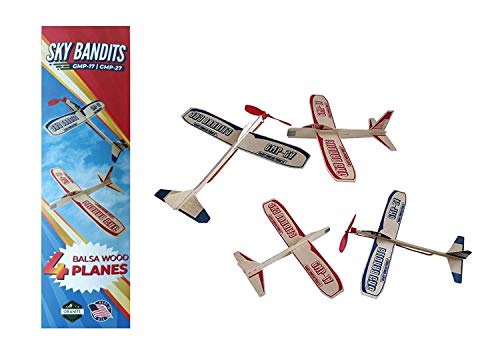
This four-pack set includes two rubber band powered propeller planes and two balsa gliders, all built with easy slot-and-tab construction and no glue required. The 12-inch wings help reach flight distances up to 50 feet, with attention to American-made craftsmanship and durable packaging to protect delicate balsawood during transit.
Best for families or classrooms seeking variety in a single purchase. It’s well suited for introducing basic propulsion concepts and the joy of building. A minor limitation is the absence of detailed instruction beyond the assembly steps, so younger kids may benefit from adult supervision during initial builds.
Guillow Paul K, INC 60 Balsa Airplane Strato Streak

The Strato Streak is a classic rubber band powered glider that requires assembly, appealing to model-building enthusiasts who enjoy precision parts and mechanical design. Built from balsa, it emphasizes traditional aerodynamics and hand-powered propulsion to achieve longer, smoother flights when correctly tuned.
Best for experienced builders who appreciate historical models and hands-on tuning. Consider this option if you want a traditional woodworking project that teaches trimming and balance; however, assembly complexity may be challenging for very young beginners.
Thames & Kosmos Rubber Band Racers Kit

Five models powered by rubber band propulsion come with a color education manual and ultralight plastic and bamboo parts. This kit emphasizes experimental learning with multiple designs, enabling comparisons of speed, distance, and energy use. It’s a strong pick for classrooms or family science projects.
Best for groups or learners who want to explore physics concepts through hands-on building and testing. A potential drawback is that some models require careful assembly, which may slow initial progress for younger children.
Rubber Band Propeller Car Kit, 10-Pack

This bulk kit lets students build ten rubber band powered cars, designed for classrooms and clubs. It includes all necessary components, enabling energy-to-motion experiments as kids wind up and race their cars. The kit emphasizes scalable learning with multiple builds in one package.
Best for large groups seeking structured, repeatable activities. A limitation is that the absence of glue means pieces must fit precisely; misalignment can affect performance, so some guidance during the first builds is helpful.
Buying Guide: Rubber Band Powered Toys
- Age and skill level: Start with simple slot-tab designs for younger builders; progress to more complex models for older kids or enthusiasts.
- Flight and distance goals: If you want longer flights, look for larger wingspan and reinforced noses; for indoor use, smaller, stable gliders work best.
- Materials: Balsa wood offers light weight and classic feel but may require careful handling; plastic and bamboo components can improve durability in classrooms.
- Ease of assembly: No-glue models are faster to deploy and ideal for group activities; glue-in models are better for long-term durability and customization.
- Educational value: Choose kits with manuals or structured activities that explain propulsion, energy transfer, and aerodynamics.
- Maintenance and replacement parts: Consider how easy it is to replace rubber bands, wheels, and wings if losses or wear occur.
Frequently Asked Questions
- What makes rubber band powered toys good for learning? They demonstrate propulsion, energy storage, and conversion to motion, providing tangible physics lessons.
- Are these kits suitable for classrooms? Yes, many sets are designed for group activities, with multiple models and clear instructions.
- Can younger children use these kits safely? Yes, with adult supervision and simple, glue-free designs that minimize tools and small parts.
- Which kit is best for a first project? The slot-tab, glue-free balsa airplane kits are typically easier for beginners and offer quick flights to boost confidence.
- How do you maximize flight distance? Ensure balanced assembly, secure wing alignment, and a smooth launch to reduce wobble and drag.
- Do these kits teach more than just flight? Many kits cover fundamental physics, including energy, propulsion, and aerodynamics concepts.